12 October 2011

The Song Does Not Remain the Same.

I think the hardest part of writing a great song is knowing when you’ve written a great song. You’d think you would know. Sometimes you do. Sometimes you think it’s horrible and it takes hundreds of people slapping you on the face with a wet fish before it sinks in that it’s got legs.

The song, not the fish. They had their chance.

Good is the biggest stumbling block there is on the way to great. Sometimes it’s easier to go around good and strike out towards great from the safe and familiar ground of being totally shit. You might be wondering what I’m talking about. And yes, I am drinking whisky.

What I’m trying to say is, you can work on a song and make it good. You can endlessly write a more appropriate chorus, work on the perfect drum fill, put in your favourite chord shapes. And you’ll end up with a good song, pat yourself on the back, and feel like a right little songsmith.

Doesn’t mean the song’s great though. It might be insipid. It might not move a mollusc, let alone a discerning music lover. But because you can point to all the good things in it, you’re blinded to the fact it just isn’t inspiring or inspired. And conversely, a song can be shit and then suddenly make the leap to brilliant. You can point at all the ways it doesn’t work, is boring, or fails in its intent, yet for some reason it all suddenly clicks together. We’re lucky - it sometimes happens to us. I’ll let you in on a secret: I didn’t think Poker was a very good song. It was terrible for the longest time, only when Mez and Whitty performed it with such wide eyed conviction did we see that there was more to it that a workout on the bass guitar.

We’re working on songs now. Songs that started life as acoustic demos I recorded during my sojourn from work in May, while the leaves grew on the trees and the sun shone down unnoticed by me. I was in a little bedroom with recording gear and an acoustic guitar. The curtains were shut, and I was on my own. Now we’re hammering them out in the practice room, sometimes reeling off new ideas with ease, sometimes bouncing off the walls in anger and pent up frustration at the songs, each other, our own fingers...

The things I’m noticing are interesting. As we make these songs our own, they change. They become leaner, we distil them down. Songs that I thought were ok when it was me and an acoustic become forces of nature with the band pounding them out. Songs I arrogantly thought would be immense and emotional might not work at all, or prove to be flat and samey. Then one of the guys will take the song and fix it with an idea so simple or so obvious that I’d never have thought of it in a million years. More than at any point in the last few years I’m feeling a connection with my three brothers. I can’t describe how it feels to watch these guys take my ideas in their hands and actually treat them with respect, with passion, and with belief.

When I first played the other guys what I’d been working on, they were my songs. Now I listen to that CD and it sounds so boring and flat. Those songs have changed, grown up, and they’re not mine any more. They belong to the band. I absolutely cannot wait to start recording them, because thanks to Alex, Mez and Whitty I think we’ve got something special on our hands.

6 March 2011

The 3 Pillars of Mixing: Water, Cement, Human Souls.

Whisky is becoming the theme linking these blog entries. It’s nearly 1am and though I’m planning on going to bed soon, I’ve got a little remaining of the wee dram I poured myself earlier, so I might as well start this. Last week I said I was going to talk through a specific mix, I’ve changed my mind; that’d be boring.

Most of the terrible mixes I’ve ever heard in my life have been my own. Nobody can just sit down and mix something that sounds great, it takes a long time to develop your ears, brain and heart to be able to plunge yourself through a wall of sound and start tinkering in a way that, when you drag yourself back out of the ocean of noise, looks pretty good from a distance. The hardest thing is being able to zone your perspective in and out, to deal with the tiniest facet of the mix while also listening to the whole sound as it lurches from verse to chorus etc.

Ears, Brain and Heart.

There are no such things as “golden ears”. Unless you’re deaf, you can hear everything I can hear when I’m mixing. That little rattle of the snare that shouldn’t be there, that weird ringing sound on the backing vocals, the way the guitars are too loud in the verse and too quiet in the chorus, you can hear it too. But you might not know what you’re hearing. You’ll just know something doesn’t sound right, that the mix sounds weak. But you can train your ears to take sounds apart, to identify the components that make them – that the murky rattle is from the snare, that the ringing sound is a room resonance at a certain frequency that you can cut out.

Mixing is the hardest my brain has ever worked. It’s totally draining. A mixing session is never finished, only abandoned, and some of my sessions go on for 7 hours or more without a break. It’s like a full day’s work except I’m concentrating! They say you’re better off taking 5 minutes to get a drink and refresh yourself, but when I’m in the room, in the sounds, I don’t want to stop. It’s all in my head; I’ll lose it if I don’t keep it there. There’s so much to remember, the mix becomes like a taxi driver’s mental road map – the bits of takes you want to bring forward, the bits you want to bury, the fact you want the backing vocals to lean towards the left of the mix to counter the tambourine that comes in halfway through the second bridge, the reverb that’s adding ambience EXCEPT for 15 seconds in the solo because you want it to stand out stark naked in that section... once you forget the details, the mix becomes cloudy, you don’t know where things are happening, why something sounds the way it does, and the whole thing runs away from you.

The Heart. It keeps my blood flowing, but we’re talking heart in the old school artsy sense – emotions, feeling. Mixing can too easily become a technical endeavour, a soulless process of making sure everything can be heard. But mixing is fucking art, man. As much art as songwriting, as performing, as painting, and much much more than interpretive dance. The mix has to move you. If you’re not jiggling in your seat, occasionally realising something awesome is happening right in front of you in the air between the speakers, give up; you’re juggling shit. What you’re doing is totally magical. You’re manipulating vibrations in the air, making the atoms around you dance with some higher purpose. You are to the music as God is to the universe. Whether or not you think God exists as some entity is totally irrelevant here, you’re him and your creation is noise.

It’s your ears that tell you where you are, your heart that tells you where you need to go, and your brain that figures out how to get there. I have some very clever friends who have tried to work out why music evolved when it doesn’t help us at all in the game of survival and reproduction. I don’t know, but empathy plays a big part in it – communication, understanding, society. It’s almost telepathy. Music is a cry. Maybe a cry for help, for understanding, for action, but if you write from your heart, then people will hear who you are. It’s no accident that we empathise with musicians we enjoy, that we use phrases like “sings with soul” or “wears his heart on his sleeve”. We understand them because they’ve taken who they are, and written it right into your brain, made your synapses fire just the way they want them to, to get you to understand. Sometimes, when music hits you totally, the hairs on your neck stand up and the shiver goes down your spine, I think you become the person who wrote it.

This is the power of music.

22 February 2011

Shake well before serving. Part 1

Mixing Part 1: The tools.

There are a number of ways to skin a cat. The same can be said of mixing. Both will leave you with blood on your hands and a very upset girlfriend. But not for the same reason. Mixing leaves you open to accusations of not having any time for your loved one, and always having the thousand yard stare of a war veteran. Skinning your girlfriend’s cat leaves you open to accusations of horrible brutality.

Luckily I've only went down one of those paths. So without further ado here is my guide to flaying domesticated mammals:


...

Only kidding. We’re talking about mixing here. More specifically, the tools that get it done. But you’re going to need to pay attention and if you don’t understand what I’m saying, ask or you’ll have to repeat the class.

Mixing is literally that: taking more than one sound and mixing them together. But if that were the end of it I suspect it wouldn’t be a thing at all any more than opening the drawer to get a teabag is a named part of “making a cup of tea”. As it is, for a mix to sound good it has to fulfil some very difficult criteria. It has to be clear in its intent. It has to generally have a balanced spectral content: that is the relative amount of low frequencies and high frequencies. Too much or too little of any frequency range makes the mix sound amateurish. Most of all it has to be true to the intention of the song. It has to somehow evoke the dynamic contrasts between sections, the tension and release of parts, and the balance of instruments as the musicians intended. It doesn’t have to be based on reality, but it does have to make you believe it’s happening. We all know a human voice isn’t as loud as a drum kit or cranked guitar amp, but when we hear songs we don’t care because it’s made to sound believable.

Each part that I’ve recorded gets its own track. Some parts get more than one track if I’ve used more than one mic, as mentioned in previous instalments of “Josh drinks whisky and talks about recording”. Each of these tracks can be raised or lowered in volume, and panned anywhere between the left and right speaker, like so: (turn up your speakers so you can clearly hear what I'm doing!)


Mixes tend to need more than just those volume and panning adjustments to sound good, though, unless it’s a simple mix or has been recorded in the most expert way imaginable. And I promise I’ve not done that. Mixes also have to cater for the deficiencies of the human ear. We think it’s a great organ, and in some ways it is – I’ve read that if it were much more sensitive we’d actually be able to hear the effect of air molecules vibrating against it in Brownian motion. So in some ways it’s as high fidelity as it’s possible to be in air. It can detect an incredible range of frequencies and process them into something we understand as sound rather than just a bunch of vibrations in the fluid that surrounds us (yep, air is a fluid!).

But ears are also totally shit. Like, f*cking blind to sound.

If you’re listening to an instrument that has lots of bass, and there’s another instrument that also has lots of bass but is quieter, you probably won’t hear the bass from the other instrument at all. You’ll just hear a muddy noise that gets in the way of you being able to hear what’s happening. This masking happens in time too. A loud sound will mask a quiet sound even if the quiet sound happens a split second before the loud sound. The result of this masking is audio confusion: Instruments that should by rights sound clear, that sound great on their own, will somehow vanish without a trace into the mix, leaving only a sense of congestion and lack of clarity.

But we have tools to combat this. Clever little tools. The most powerful of these is the EQ (short for equalisation). It’s one of the first effects they ever made, because they needed it. With EQ we can filter out frequencies we don’t want to hear or wouldn’t hear anyway, add frequencies where there are gaps in the mix to help a sound cut through, get rid of bad sounds and emphasise good ones. Sometimes I think of mixing as being like trying to push a bunch of big plasticine shapes onto a little pane of glass, and having to somehow change the shapes to make them all fit while still keeping them recognisable. Sorry if that’s a stupid analogy, I genuinely imagine this when I’m mixing!


The next most powerful tool is compression. It’s a mysterious tool that takes years to understand, let alone master. At its most simple, it compresses the volume range of whatever you put into it – the loud and quiet bits come out more even in volume than they were before. This is handy. A good live band can go from whisper quiet to roaring, and that sounds great live but it wouldn’t work on a recording as you drive along in your car or listen on the bus: Make it loud enough to hear the quiet bits and the loud bits would destroy you, make it quiet enough that the loud bits are fine and you wouldn’t hear the quiet bits. Almost all recordings, even classical ones, have compression for this reason. And used sparingly, we don’t even notice, because we expect to hear the loud and quiet bits clearly and our ears actually compress by themselves at high volumes.

Compression has more tricks to reveal. Weird little controls labelled “attack” and “release”. What do they do? Attack tells the compressor how long it should wait after it hears a loud sound before it actually reduces the volume of the loud bit. So if you set it to a second, the first second of any loud sound gets through unaffected before the compressor cottons on to you and ducks the volume down. In practice, a second is too long. Reduce it to between 20 and 60 milliseconds or so and you get this great loud and punchy spike at the beginning of each loud part, but then the compressor kicks in and keeps the rest of the volume manageable. That initial loud spike grabs the attention of your ear and makes them think “Oh! A loud bit! This is cool.” Except it’s not actually loud for the rest of the time. It’s just a trick.

The release knob tells the compressor how long after it’s stopped hearing a loud sound it should wait before it stops clamping down on the volume. This knob is really difficult to get right, mainly because even after years of mixing I often can’t tell the difference. But sometimes I can, and there’s usually a setting that “feels” good even if I couldn’t tell you exactly why I prefer it. But for a simple example, imagine Drummer boy is hitting the bass drum 4 times a second. If I set the release to more than a quarter of a second, the compressor isn’t releasing its grip on the volume by the time the next bass drum hit happens, so it will never give me the punchy attack I want: it’s operating too slowly.

Compression is hard to get your head around, Again, turn this up and you'll hear what's happening better:


Really, EQ and compression are the two most powerful mix tools you’ve got – you can shape the sounds hugely with these two, and mixes have been done without anything else. There are other effects that can get pretty fun. Reverb is one, echo is another. Reverb is important – without it the sound is dead, and has no context. We’re not used to hearing no reverb. The first time I stood in a totally dead sounding room was the weirdest thing I’ve experienced. People next to me sounded 10 meters away, yet I could hear the slightest whoosh of air from a closing door. Or a sphincter. No hiding in there.

So, those are the most important tools. Next week, I’ll talk through the actual mixing of one of the songs on the EP.

Hold on to your cats, it might be a wild ride.

16 February 2011

You are a spark, shining in the darkness.

Vocals should be easy to record. One microphone, sing into it, bam.

That’s actually pretty much how it goes, from a technical point of view. On the first vocal session we tried out four mics, picked the best one, and put the rest away.

The bit that isn’t technical or easy is the performance. Vocals need to be as convincing as they are well executed – when we listen to music, we have a whole section of our brain dedicated just to listening to voices. And not just listening – we judge those voices based on timbre, pitch and delivery, even before we get into what’s actually being said.

It’s harder to get it right in the studio than a live show. Watching a live vocalist brings the rest of your critical brain into play too, watching the expressions on the singer’s face and the way they move to the music.  With our singer it’s quite easy to tell that yes, he’s into it, and yes, it’s moving him. He sings from the heart. The fact he’s grabbed YOU by the cheeks and is trying to sing straight into your soul is a clue.

On record, all we have is a voice. That voice is the most important thing on the record, because it has to reach through time and space and move you, the listener. And that voice is naked. You can hear any wavering notes, any off key moments, and you will hear them because your brain will draw them to your attention – “HERE! HERE IS A WEAKNESS!” I promise you, if the singer is going through the motions, you’ll be able to tell. How can you be moved by a recording of someone who isn’t feeling moved?


Our singer is called Whitty. I’ve never met anyone even remotely like him before.

My favourite ever Whitty recording moment came during the recording of our last EP – Whitty had his first go of opening track “Poker” and it was pretty good, but didn’t quite have the attitude. Chris, the recording guy, told him to give it some more bollocks. Whitty took his trousers off for the next take. He was literally hanging it all out there for the world to see, but for the slight obscuration by speakers, a bunch of wire, and a mic.

He delivered that vocal to us.

The man takes it seriously. He gets pumped up. He stretches. He does his best at times to be insufferable because he knows it’s a performance just like any other. His worst takes would shame most people.

With a strong vocalist like Whitty there are two main things to be judging in each vocal take, and I try to keep them in my mind as I’m choosing vocal takes, cutting lines and phrases, looking for the perfect vocal.

Pitch and attitude.

It’s natural that when singers get excited, go for the high notes, or try to create tension, they’ll place parts of their melodies slightly out of tune. It’s not bad or wrong, it’s one of the ways a good vocalist expresses himself and sounds human. It’s the reason I hate autotune – remove these “mistakes” and you remove the soul.

Sometimes you’ll have a part that is sung to perfection in one take, and with complete attitude and conviction in another take even if the pitching isn’t as good. You’ve got to decide which one is better, leaning as far as you can into the realm of soul and guttural truth without sounding like a wild pack of dogs barking into the night.

I like to think that me and Whitty are two people balancing each other on the line between genius and madness, but I’m never quite sure who’s on which side.

7 February 2011

Me. On Me. By Me. With added foreword by ANGUS YOUNG!!!

This blog is absolutely rubbish, and the post below in particular on the subject of guitars completely misses the mark. I don't know what else I can say about this waste, this travesty, this injustice.

- Angus Young, Feb 2011
_________________________________________________

What is my all time favourite movie moment?

It isn’t the pivotal scene in 2001: A Space Odyssey where the bone thrown into the air cuts seamlessly into the spacecraft. Nor is it the beach assault from Apocalypse Now. Nor even is it Captain Kirk shouting “KAAAAAAHHHHHNNNNN!!!!!!!!” across the vacuum of space. No, nothing that epic. For me, it’s when Mr Bean gets up to do an improvised speech about the painting “Whistler’s Mother” in Mr Bean: the Movie. For some reason the idea of talking about guitars makes me think of that scene.

Hello, I’m guitarist Josh...

...apparently...

And my job is to make noises by hitting the guitar.

What can I say about guitars? Well for one thing, they’re very loud. Which is good. Because if they weren’t, then hardly anyone would be able to hear them.”

Guitar has become ingrained in culture as an icon, artefact, and status symbol to those who care. It’s hard to work out what to say about it. Everyone has their own ideas ranging from the noise a guitar is supposed to make, to the faces you should pull when you do a solo. Here’s my favourite guitar. It’s a Gibson Explorer from 2007 I believe. Nothing that special, I changed the stock pickups for slightly smoother and smoky sounding ones.


I think my outlook is a little different from some other guitarists. The guitar is seen as the instrument – the thing you either coax beauty out of or wrestle with, depending on your outlook and style. I don’t think of the guitar as my instrument. My instrument is the amplifier.

The guitar amp is even more important than the Electric Guitar. Without the amp, there is no “Electric” anyway. I said last week that the bass guitar sounds recognisable no matter what you plug it into. The same can’t be said of the guitar. Its natural tone is thin, twangy, honky... it's just bad. It’s the amplifier and speakers you plug it into that make it sound full, thick, aggressive and alive. Don’t get me wrong, a good guitar is better to play, but given the choice between a shit guitar with a great amp, and a great guitar with a shit amp, I’d chose the shit guitar every time. Some players are famous for their relationship with one guitar, their “signature” model. I have a relationship with my amp. It’s the one constant in all my sounds.


This is my Vox AC30. It’s a new model (2007) that I’ve made some alterations to so that it responds to my playing the way I want. It’s got a chiming clean sound with a rich tone. On its own it is a little brash sounding but that’s because it’s designed to sound good in a mix with bass and drums – the brashness ends up sounding clear and forward. Famous AC30 users include the Beatles, the Edge, Brian May, and Peter Buck, but it’s been on so many records I couldn’t list them. It’s not a very cool amp – it looks more like a piece of furniture from the 1950’s, because that’s when it was designed. Often, bands will pretend to play through a wall of screaming marshalls, but behind them the sound will actually be coming from one unassuming AC30. It’s believed the quintessential guitar riff from Smoke on the Water was recorded with an AC30.

When you turn it up magic happens, as with most decent guitar amps – it’s what makes them so important to me. It distorts the sound, runs out of power and squashes the tones so even the quietest note you play seems to jump out of the speaker. The high end fizzy sounds smooth out, the bass seems to tuck in like a jet plane’s undercarriage, and the amp sings. Maybe it’s screaming because it’s being pushed so hard, but it’s my favourite sound, and the way it responds and changes the feel of my playing influences how I play. It’s a symbiotic relationship and as I’m writing about it I’m thinking to myself I fucking love this amp. It’s like the relationship between a loyal dog and his owner. Except I think I’m the dog.

This is the amp in all of our recordings. Recording a guitar amp is a strange process because what sounds good in the room doesn’t seem to come across easily on record. Without touching the amp’s controls at all, just by moving the microphone on the speaker, you can go from a sound that’s muffled and dull to one that’s completely harsh and ear piercing. Somewhere in between is the sound you’re looking for. It’s a testament to how bad guitars naturally sound that they need to be plugged into amps that completely distort and mangle them to give us something usable. And the most commonly used mic to record guitars throughout the world is the Shure SM57 – there’s two in the picture below. It’s not a transparent high quality mic. It completely colours the tone of any sound you record it with. You can get them new for £60, which when you compare that to one of the industry standard vocal mics (at £1200 for the basic model) is nothing at all.


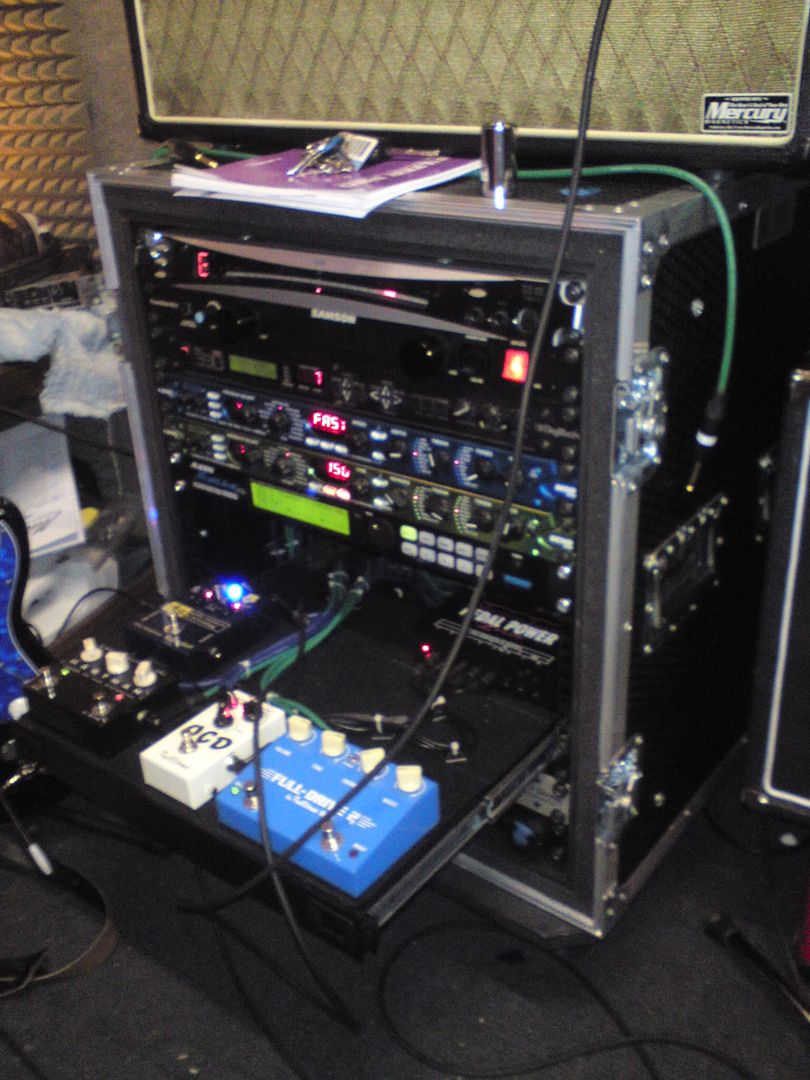
Those who have seen me live will think yeah ok, he talks about his amp, but what about his fucking stupid rack of effects? Don’t they play some part in it? Those who have helped me lift said rack will probably get angry at this point. What's the point in it? Aren't they important?


Yes, they are. I love effects. I love the variety of sounds you can create – the ambient washes of noise, the sense of depth you can make. But they, just like the guitar I’m playing, all feed into the amp. I guess it’s all one big instrument.

It’s a lonely life recording the guitars because I’m there by myself, wearing two hats at once – the performer’s hat, and the engineer’s hat. I find I’m good at doing both things at once because I’ve done that as long as I’ve been playing guitar. Where I suffer is that I lose perspective. By which I mean, I might get a great tone and play well on a song, but it’ll be the wrong tone for the song and then I need to go and do it all again. That happens regularly. If we had a producer he’d probably keep me right but he’d have to get his hat back from under the performer’s and engineer’s hats on my head.

It is fun though. Guitar recording lets you get creative, and I like to treat the basic drum and bass tracks as a blank canvass. I never just play the part I play live. I always record different sections, layer different tones and doubles, experiment with effects, and above all else, I improvise. I don’t do that much live, but in the studio with time to spare I absolutely love to let loose and just see what accidentally comes off my fingers. And because I’m the one mixing it, I can really do what I like. No one but me will decide whether it makes it to the final mix, or even if anyone but me will ever hear the results.

You can see why I lose perspective.

1 February 2011

Bass is the place, bass is the place, bass is the play-ay-ace, bass is the place.

“Is that it then? Next song?”

“No, we’ve only done two takes so far... I noticed it wasn’t quite meshing in the middle 8”

“...oh.”

Alex does not like recording. He doesn't understand it. He doesn't know why it's happening to him. Alex turns up, sets up his rig exactly as if it’s a gig, and gets confused that no one applauds him after each take. I feel for him. He's just not excited by it. Don't get me wrong, the songs excite him, the performances excite him, the finished mixes excite him, and the idea that we're going to release them on an unsuspecting world excites him. But the in between stages hold no allure for Alex. I play him half finished mixes, saying things like "listen to the drums here! Can you feel that compression!?" and he to date has only ever had the following suggestion:

"I think the bass part in (insert song section) is (too loud/ too quiet/ not powerful enough)."

I think there’s one in every band, I have to believe it’s not just us. He doesn’t listen to the whole mix. If he did, he’d find out there’s a guitarist in the band too. He only knows if the bass is too loud, or the bass is too quiet. Alex doesn’t want to embark down the road towards understanding what makes a production good, he keeps his head down and hopes his playing isn’t going to ruin everything. He is the ugly hidden face of recording a band. In his world, there would be no recording and everyone would be compelled by law to attend massive concerts in which he, the bass player, was the star of the show and amplified so loud that it caused anyone within 10 miles to be sick, and anyone within 300 yards of the stage to get what doctors would call "gooey eyeball caused by liquefaction of innards".

I might have digressed a bit here. You get the idea.

The bass and vocals are probably the constants in this bunch of recordings – as is the case on many records, I think. We change the drum mics, tuning and at times the drums themselves around depending on the mood of the songs. Like many guitarists, I change my tones depending on the part I’m playing. I’ll talk about that next week. In a mix, guitars are multitracked, drums and percussion get lots of different tracks, panning, treatments... but bass? There’s one bass track per song. I think it’s the unifying thread that runs through our songs and makes the recordings work together. Musically, it’s the bridge between rhythm and melody, the anchor pin, the keystone that holds the whole band together.

Some people think that a bass guitar is like a bigger, deeper electric guitar but it’s not, it’s completely different. Electric guitars sound absolutely dreadful – if you can, try plugging a guitar into a hi-fi or a PA system. They sound thin, clicky, choked, lifeless... just bad. You need to plug them into something else that distorts terribly (namely a guitar amp) to make them useable at all. Bass, not so. Plug a bass guitar into anything at all and it comes across pretty much like the sound we all know and recognise as “bass guitar”. Sure, different amps and recording styles can colour what you hear, but they can’t fundamentally change what is being played on the instrument. Unlike a guitar, where some fantastic sounds can come from terrible performances (this fact has saved my bacon many times).

Whether or not it sounds good, therefore, is literally in the hands of the bass player. How consistently they play each note. Which bit of the string they pluck. Whether they mute a note before playing the next. It all counts. Like Mez, Alex can deliver the goods when he needs to. We recorded the bass parts over a couple of days, mostly using Alex’s trusty Ampeg stack.


It’s a general rule when recording bass guitar that people take a direct recording of the bass to process later. That is, the electrical signal is split straight into the recorder as well as going through the bass amp. That’s a safe thing to do, because it gives you an uncoloured recording of the bass which you can mess around with later. I didn’t do that, because I like Alex’s bass amp. It’s the sound I want everyone to hear. He plays an Ampeg stack which is about as tall as a person. I like the Ampeg because it adds authority to the tone, and filters the sound in a nice way that sits well in a mix – the high end of a bass can be clacky and clicky in a bad way, the Ampeg makes it aggressive, twangy and defined. The bass can be boomy, the Ampeg makes it growl and rumble without overpowering the mix.

At one stage, we did split the signal. But not to go straight into the recorder: We split the signal between the Ampeg stack and one of my AC30 guitar amps, for a blend of clear bass and fuzzy distorted goodness. That was fun, and quite loud.

I’ve not told you about the bass guitar being used, yet. It’s made of Cocobolo wood, which is so strong and dense that when they make these basses, they have to make them at the end of a production run because it destroys the tools used to shape it. That makes it very resonant – even if you play it unplugged, it seems to sing to you, otherworldly harmonics wafting out of the body. And that’s good.

Alex was genuinely worried having heard the drum tracks that he was going to ruin what we’d done so far, but he did no such thing. He played the tracks with precision and punch, just like he always does. Maybe in his head, the recording session was a gig after all, his audience just displaced a little in space and time.

24 January 2011

Dance like sheep to the rhythm of the war drums

Phantom tracks recorded. The next step: drum takes. Mez is a very good drummer, and he always rises to the occasion. Drum sounds and performances however are some of the hardest things to get right – second only to the lead vocal, I think. The drum kit has massive dynamics and tones, from whisper quiet to so loud that you flinch.

Firstly, the drum kit has to sound good, otherwise there’s no point recording it. That involves replacing heads, looking for rattles and squeaks, and endless tuning. Honestly, unless you’ve done it I’m not sure you can imagine. I remember when I thought tuning a guitar was hard work. But a single drum head has between 6 and 10 lugs to adjust, each of them needing to be just right to even make that head be in tune with itself. Then you’ve got to make the relative tuning between the top and bottom head right. Then you’ve got to get the relative tuning between the different drums right. Oh, and if you turn any lug, it adjusts the tuning both at the adjacent lugs and the lug opposite. Oh, and if you hit the drum, it'll go out of tune. Oh, and if the temperature changes or the pressure or the humidity changes or you move the drum or look at it critically, it'll go out of tune.

Who the fuck thought that was a good idea?

But between me and Mez, we did it. We took extra care on the snare drum. I think of the snare drum as the nose of the mix – a terrible nose on an otherwise beautiful face is bad news. It’s right there in the middle, it sticks out, you can’t ignore it. It’s amazing how the sound of the snare completely defines the sound of a mix - it’s the single hardest thing to get right. Get it wrong and the recording is instantly cast down into the fiery hell of shit demos. Forever.

You can’t afford to get the snare sound wrong. Too deep, and you become an 80’s revival band. To reverberant and you’re trying to be Pearl Jam – it’s all anyone will compare you to. Too dry and you’re Fleetwood Mac. You must get it fucking right. Mez has a really nice wooden snare. It's got a bright crack to it that cuts through well, but also has satisfying body and a hint of snare wire crispiness. But on some songs we used a more mellow snare rented from the studio upstairs.

Drums sounding as we wanted, we tamed the sound of the room a bit. Our room has similar dimensions to a big shoe box turned onto its long side. Close, parallel walls are bad news for drum sounds because the drum hits echo off each wall, bouncing back and forward in a ping pong effect. You might have heard it if you’ve ever clapped your hands in an empty room that’s being redecorated; it’s a boingy, flappy reverb that sounds like it’s been lifted from the effects track of The Animaniacs. It smears the sound of the drums and makes them sound cheap. To combat that, I did a thing that I’d heard about, but never done before. I made something.


8 sound absorbing panels – pictured here making a sort of guitar amp rabbit hutch, but which got their first use being placed around the drums, especially either side along the nearest two walls. We hung two duvets from the roof to stop sound bouncing back down too. And it really worked. The drums sounded much more focussed and clear. And when we put microphones round the kit, we could hear the difference.

There are two extremes when it comes to miking up a drum kit. You can put one “big picture” mic up. Or you can use 20 or more, focussed on every tiny detail. We can record 10 things at once with our gear, so we used our 10 mics. Simple. The basic drum sound came from two overhead mics, giving a bright, lively sound and a stereo spread when panned left and right. Then we used mics placed very close to each individual drum to add depth and punch to the sound. The snare got two mics because as I said, it’s important. So did the bass drum: one put right inside the drum through a hole in the front head to get lots of click and attack, and another about 4 feet back at floor level to get a nice bassy thump. Blended together, you get a nice bassy thump, click and attack. Predictably. It doesn’t sound that natural, but it sounds big and clear in a mix so it’s all good.

How long did it take? About 4 days to record 10 drum parts. We took our time, went for pub lunches – the whole point of recording in our own place is so that we don’t have to rush. We adjusted the drum sounds between songs and let the sessions flow – sometimes fast and aggressive, churning out take after take, sometimes relaxed with plenty of time to chat between playing.

Mez was fantastic. The man can play the drums, a fact I’m prone to forget when we’re all knackered at 10pm on a Thursday after a hard week at work. Yep, we’re all babies. Hard working, hard rocking babies. The kind of babies you wouldn’t like to mess with. Baby killers. Or rather, Killer Babies.

Killer babies with killer drum tracks. I was pleased.

Next stop: Bass.

19 January 2011

Phantoms

Everyone and their dog can record these days. Anyone who tries to make a living recording music knows this, and fears it. Their clients don't go to them anymore. Their mic collections, good sounding rooms, £50k mixing desks, mean nothing to the excited musician who is trying to record their acoustic guitar on a new £200 computer recording interface.

Part of me feels guilty for contributing to this problem. But the recording industry being what it is today, we can't hold out much hope of getting a record label to pay for us to go to an incredible studio. They want us to walk into their offices with a finished product they can sell. We can't afford excuses - "Oh, the drums don't sound very good because we couldn't afford new heads", "Yes, the lead vocal is a bit sibilant, in an ideal world we'd have had the time to fix that...".

To me though, the difference between a basement demo and a big budget studio production is a lot more than just the sound quality. I think people can get hung up on sound quality, the clarity, the beautiful tones, and use that as a judge of the music. Some fantastic records, huge hits, have glaring production flaws but they still sound brilliant. No, the difference between a good and bad record is the feel of the music. A good song recorded badly is a good song. A bad song recorded well just lets people know exactly how much the artist sucks. My favourite producer is Daniel Lanois, and he likes to say that a good performance equals a good mix. I didn't know what he meant until the first time I tried to mix a bad performance. No matter what you do to it, you're compromising, trying to hide flaws. But if everyone plays well, the mix is almost irrelevant. Even if something is too loud, it doesn't matter - because it's worth hearing.

So with our album, my main concern hasn't been the quality of the recording, but the quality of the performances. If we all played together, it'd be easy - we could just keep playing until we get a take that feels good, and that'd be it. But we can't do that.

Why can't we do it? This is why:


Our recording space isn't big enough. It's our practice studio, so we obviously can physically get in there and play music together. But all the noise making things are so close together, it'd be impossible to get a great recorded sound. People think of microphones with some reverence. But they're just like crap ears really. Imagine what it would sound like to have 15 half deaf ears all over a small room an insanely loud rock band was playing in. Ok, that's hard to imagine so I'll help you: It'd sound awful. Guitar sounds spilling through the drum mikes, bass rumbling through EVERYTHING with as many different tones as there are mikes in the room, that's just two of the terrible problems that would confront me when it came time to mix what we recorded.

And I don't want that. Not even a little bit. Mainly because when we we're recording we'd be all pumped and thinking it sounds great, then after months of mixing I'd present the other guys and you with a record that sounds like the musical equivalent of a Yorkshire pudding that didn't rise. Or a Chocolate cake with 6 raw, rotten eggs in the middle.

No thanks.
Instead, we needed to record each part separately, but somehow perform as if we were playing together. It's not such an easy task for musicians who aren't very used to it. Imagine you're a bassist, playing along to a drummer. You're not just playing along with what you hear, you're also playing along with what you see and feel. You can see the drummers arms swing through the air, so you can predict the exact point his sticks are going to hit each drum. You can see him bopping away on his stool - his legs move in time with the music, his head nods to the beat - so as well as hearing and seeing what he is playing, you can see how the music is making him feel, what the beat in his head is doing. You can feel the sound from the drums too - the kick drum makes the floor you're standing on shake. And likewise, he can hear, feel and see your bass playing, and will adjust his performance to more closely match yours.

Now record that drummer, and play your bass along to the recording. You can't see him anymore. You can't feel his playing. And he isn't reacting to you anymore. So your playing changes, and becomes less natural, less tight. That makes the recording feel worse, and illustrates the problem with recording bit by bit. So how did we get round that sticky wee issue?

I pondered the dilemma for weeks. I went trekking in distant mountains. I stood in the line for the self service checkouts in Tesco’s, and smashed a beer bottle at the feet of the couple that inevitably pushed in front of me. My manic stare cowed them into submission. I slunk off to my car, still pondering. Then I had what I thought was a great original idea, until I learned that loads of people do it.

We started recording takes of the whole band playing together, with not too much regard for how the recording actually sounded - it was just a "feel template" or as Alex immediately dubbed it, a "phantom" of the proper recording. Then once we'd got a good take of each song we wanted to record, we recorded Mez playing the drums over the top of it - so Mez was hearing and playing along to a recording of the band who had been listening to and reacting to Mez's drums, which meant that even though he was playing along to a recording in his headphones, it was a recording that reacted to the way Mez plays drums.

Simple, maybe. Confused? Sorry.

But by recording a phantom performance and then overdubbing separate performances on top of that, we've been getting the feel of playing together, even though the actual keeper takes are recorded separately, with the various advantages that provides - cleaner sound, the ability to really concentrate on the fine details of each performance and having the whole room and all our gear just to get the best sound we can out of one instrument at a time.

11 January 2011

Like a mighty Oak, this diary isn't.

This is the first entry in the diary of a project has been going on since October. Oops!

I'm better at doing things than writing about them. I've tried it on and off in various blogs around the internet - Livejournal, Myspace, the awesome Jevon Journal (google it!) which half chronicals my difficult teenage phase... I just looked out my old user name and password, and let me tell you it's difficult to read some of the stuff the whiny insecure 15 year old Josh wrote. Recording something, words or music, that you can enjoy later without being embarrassed or ashamed is hard, sometimes it's impossible if the emotions live in that moment.

Yep, recording is tough. Especially when you're a band that's built on live gigs, performing, making the most of the limitations you have when there are 4 people, one of whom needs a hand free to swing from the roof. Play rock music loud and the audience can feel it. It hits them like a force of nature. Basslines shake the room. Drums thump chests as fists thump the air. A human voice amplified to many times its normal level is hard to ignore. Live rock music is a force and when you can harness that force you're in for a wild ride.

Just now, we're try to record it. Compress it. Shrink it all down and keep the essence of Captain Horizon. It's very rare that you can just do what you do live and expect it to work, because you are only making an illusion of a performance for people to hear from their hi-fi's, computer speakers, earphones, plain old mobile phones... 50 years of pop recording has given us a pretty solid idea of what a recording should sound like. Make it just like live sound but much, much quieter, and most people won't like it - too raw, too rough. If you're reading this, you might be one who does like that. You might prefer it without the gloss, the extra tracks, the freedom to decide as an intelligent kinda guy how good THE SONG is. But most would get confused without the help of some production, and too often equate raw with bad. I like production, I think it only gets bad when the production gets in the way of THE SONG. THE SONG is the heart of what we're doing.

So where do I draw the line? I think recording and mixing are art. Art imitates life, but push it a bit harder and it will transcend it. Go too far and it becomes fake, unbelievable. I think we passed that point a long time ago in popular music. Put on the radio now and you hear perfection for perfection's sake. Vocals autotuned by computer to technical perfection. Drum parts split into individual hits and re-aligned to a perfect grid, graph paper on the screen. The modern sound is a very narrow path. Deviate from it at your peril. Music is the most pure way I know to communicate an emotion. You can hook people, pull their heart strings, show them how you feel. But if everything is perfect there is no feel.

We like feel, but we're not afraid to use the studio as an instrument. Ever since Les Paul modified his tape recorder to allow the layering of sound on sound, people have done things that they couldn't do live. I think that's fantastic. Recording isn't live. If a song sounds fuller with an extra acoustic guitar, record an acoustic guitar. If it sounds cool to have the same part layered twice, we do it. There's a bit at the start of Turn Away where I ran the guitar through effects until it became a wash of noise. I could never do it live, but it's cool and I want you to hear it. But what we're not doing is making you believe we can play things we can't play, sing things we can't sing. There's no autotune. There's no beat correcting. It's a good feeling, honesty, even if it can be a pain when you need to do something again and again until it's right. Maybe you'll hear that when we release these songs. The bit where that one fill took 6 takes. The guitar solo that took 20. Or the first take that is absolutely perfect, never to be beaten.

So far we've recorded 10 songs, with more yet to be started. I'm mixing every day I can, as the ever mounting piles of empty Coke cans and Tesco sandwich packs either side of the mixing desk testifies. You can follow the trails on the dusty console where my fingers trace well worn paths - volume up and down, check in mono, pull the bottom out the mix to see if it works on shit speakers. Cables snake the room, layers of them, some under the drums, others over - I'm good at plugging cables in, less good with remembering to coil them back up and tidy them away. Luckily (debatable) I've got plenty cables. We're recording onto a computer, tape is a luxury we can't afford. The battery is going dead, every time I turn the computer on it thinks it's midnight, January 1st 2007. Mix for three hours and the desktop clock says it's 3 in the morning. Listening to proto-mixes in a windowless room with carpet on the walls, I sometimes struggle not to believe it.

We're hitting on a sound though. I've always thought we were a hard band to catagorise - descriptions ranging from pop rock to post grunge, alt rock, there are lots of conflicting drives in us. We want to be the next Oasis, the next Incubus, the next Floyd, the next Motorhead. And do it all in every song. We're making an album that's going to work together, from hard hitting El Nibre to the stunned, gentle throb of Strong Enough, them, everything in between, more beside, they're all Captain Horizon.

- Josh